North East councils collaboratively developed a data‑driven regional mobile signal survey and mapping platform, combining a staff app and targeted surveys to generate shared, evidence‑based insight. The initiative enables councils to identify notspots, engage mobile network operators, and influence investment using consistent, locally-owned data.
Existing tools for mobile signal mapping often rely on limited sample sizes, such as devices connected to waste vehicles, or point‑in‑time readings. While valuable, these approaches do not reflect changing demand on mobile networks. Operator and Ofcom modelling also fails to match lived experience, particularly in rural areas, visitor hotspots, deep urban valleys and dense housing estates. Coverage claims frequently conflict with resident complaints, service delivery issues and councillor casework, leaving authorities without credible evidence to challenge providers or prioritise intervention.
In response, regional digital leads collaborated to design a shared, data‑led solution: a council‑owned and governed mobile Signal Survey app and mapping platform. Both the app and the data it generates are designed to be freely shared and adopted by others.
Working with HR and unions, the app has been deployed across around 17,000 managed council devices. It passively collects anonymised, real‑world signal data during normal duties, at minimal cost and without additional equipment. Rollout was coordinated across authorities using different mobile networks to ensure multi‑operator insight. By January 2026, over 5.5 million records had been collected and converted into a cleaned, structured dataset linked to GIS mapping. The app is also available via the Google Play Store, enabling staff and residents to contribute from personal devices.
Councils can now visualise signal quality, reading density, provider‑specific performance and repeatable blackspots at regional, local and street levels. This has revealed operator‑specific notspots and persistent poor service previously obscured by coverage models. To address gaps in crowdsourced data, a complementary targeted survey capability was introduced. Using a low‑cost “box” of standard smartphones running different networks, councils can undertake high‑frequency, identifiable surveys. This supports rapid validation of complaints, visitor hotspots and transport corridors, strengthening engagement with operators.
Outputs feed into a shared regional map (screen shots) and evidence pack supporting engagement with the North East Mayoral Strategic Authority (NEMSA), central government, MPs and delivery bodies. Authorities can identify and prioritise notspots using a consistent regional methodology, rather than working in isolation. The initiative demonstrates a new public sector model based on collaboration, open data sharing, repurposing existing assets and staff participation.
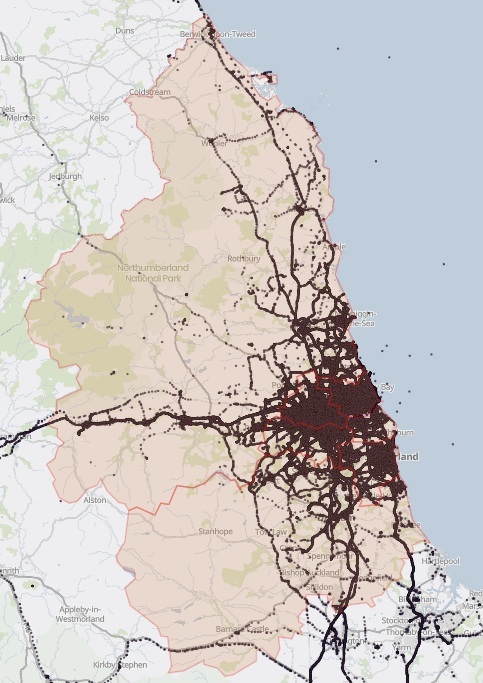
A key benefit is that data remains openly accessible to councils rather than locked in commercial arrangements, ensuring ownership, reuse and ongoing analysis, while supporting collaboration with industry and government partners.
This approach strengthens authorities’ ability to target intervention, prioritise need and base investment on lived experience. It also supports digital inclusion by addressing a fundamental enabler: reliable mobile connectivity where people live, work and travel. Mobile phones are often the most accessible way to get online, particularly in deprived communities.
By generating independent, real‑world evidence across urban, rural and low‑footfall areas, the project exposes persistent notspots affecting access to public services, employment, healthcare and participation, helping ensure no area is left behind as connectivity becomes an essential utility.
This approach is already transforming how councils evidence connectivity gaps. It has exposed persistent, provider-specific notspots at scale—often contradicting national coverage claims—and equipped seven councils and NEMSA with shared data, live maps and repeatable survey tools. Authorities are now confidently prioritising need, validating complaints and influencing operator engagement using consistent, defensible evidence. Low-cost, scalable and built on reused devices, the model proves that collaborative, council-owned data can deliver immediate and lasting public value.
if you live in the region and have an Android phone you can help us survey mobile connectivity by downloading and activating the Signal Survey App from the Google Play Store.
 North Eastern ICT Partnership